5 Crucial Films for Understanding Philosophy (And Where to Start)
Discover 5 essential films that explain complex philosophical concepts, from The Matrix to The Seventh Seal. Perfect for students and cinephiles.
Philosophy can often feel impenetrable. When you are staring down the barrel of a 600-page text by Kant or Hegel, it is easy to lose sight of the human questions at the core of the work.
This is where cinema becomes an essential tool. The best films do not just tell stories; they are "thought experiments" in motion. They allow us to test philosophical concepts - like the nature of reality, free will, or the existence of God - in a way that dry academic texts cannot.
Whether you are a philosophy student looking for a break from the library, or a film lover wanting to deepen your analysis, here are five crucial films that perfectly bridge the gap between cinema and philosophy.
1. The Matrix (1999)
The Concept: Epistemology & Simulation Theory
The Philosopher: Plato / René Descartes
It is the most obvious choice, but it is impossible to exclude. The Wachowskis’ sci-fi classic is essentially a modern retelling of Plato’s Allegory of the Cave. In Plato's myth, prisoners are chained in a cave, watching shadows on a wall and believing them to be real. In the film, Neo discovers that his entire life in 1999 is a digital shadow - a simulation designed to blind him from the truth.
It also serves as a perfect introduction to René Descartes’ "Evil Demon" argument. Descartes asked: How do I know my senses aren't being manipulated by a powerful deceiver? The Matrix takes this abstract fear and makes it literal.
2. The Seventh Seal (1957)
The Concept: Existentialism & The Silence of God
The Philosopher: Søren Kierkegaard / Jean-Paul Sartre
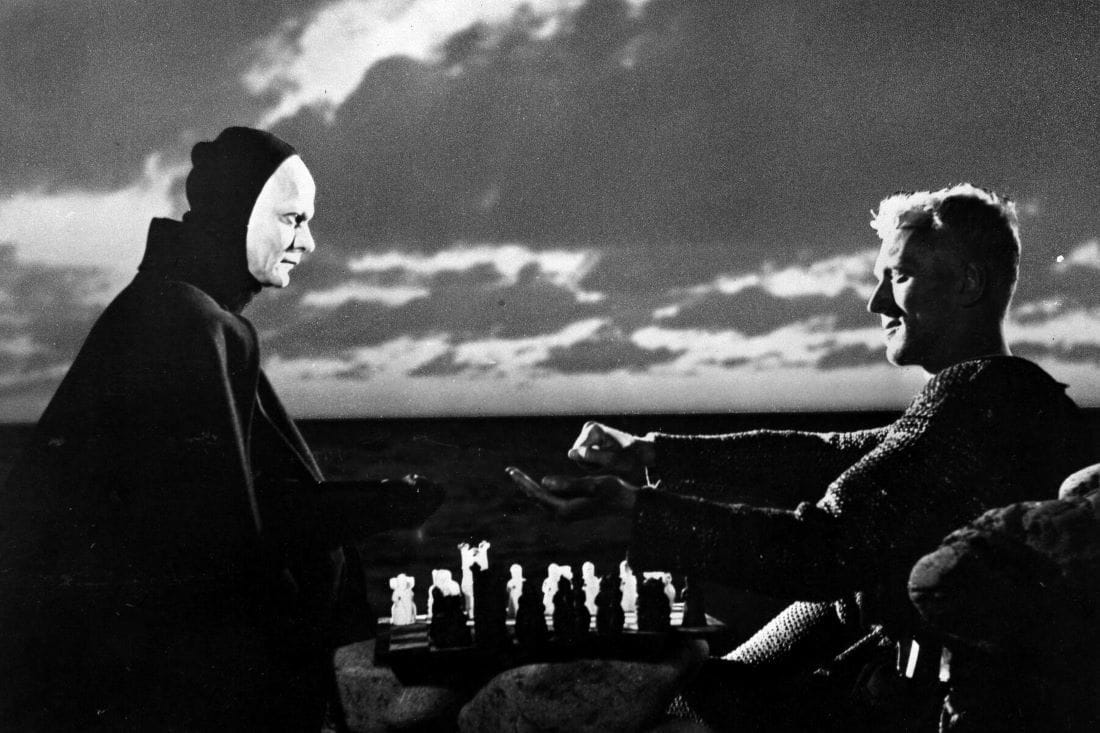
Ingmar Bergman’s masterpiece is the definitive film about the "Silence of God." A knight returns from the Crusades to find his homeland ravaged by the plague. Disillusioned and doubting God’s existence, he challenges Death to a game of chess to buy himself time.
The film visualizes the core struggle of Existentialism: if God is silent (or dead), and death is inevitable, how do we find meaning? The Knight is the ultimate Kierkegaardian hero, desperate for a leap of faith but paralyzed by his own rationality. It is a stark, beautiful meditation on mortality that every student of continental philosophy must watch.
3. Eternal Sunshine of the Spotless Mind (2004)
The Concept: Personal Identity & Memory
The Philosopher: John Locke
If you could erase the memory of a painful breakup, would you? And if you did, would you still be "you"? This film explores the philosophy of mind, specifically John Locke’s theory of identity. Locke argued that identity is tied to continuity of consciousness - essentially, our memories make us who we are.
As the protagonist Joel (Jim Carrey) undergoes a procedure to wipe his ex-girlfriend Clementine from his mind, he realizes that by destroying the memory of her, he is destroying a part of himself. It challenges us to ask if we are just a collection of our past experiences, or something more.
4. Arrival (2016)
The Concept: Philosophy of Language
The Philosopher: Ludwig Wittgenstein
"The limits of my language mean the limits of my world." This famous quote by Ludwig Wittgenstein is the heartbeat of Arrival. The film centers on a linguist (Amy Adams) trying to communicate with aliens who experience time non-linearly.
The story relies on the Sapir-Whorf Hypothesis (Linguistic Relativity) - the idea that the language we speak determines how we think and perceive reality. As the protagonist learns the alien language, her perception of time itself begins to rewire. It is a profound look at how syntax and vocabulary shape our entire existence.
5. A Clockwork Orange (1971)
The Concept: Ethics & Free Will
The Philosopher: St. Augustine / Jeremy Bentham
Stanley Kubrick’s adaptation of Anthony Burgess’s novel is a brutal examination of free will. The protagonist, Alex, is a violent criminal who undergoes a state-sponsored therapy that physically sickens him whenever he tries to commit violence. He becomes "good," but only because he has lost the ability to choose "bad."
This poses a terrifying ethical question: Is a man who is forced to be good actually moral? Or does morality require the freedom to choose evil? It is a clash between Utilitarianism (societal safety) and the sanctity of human Free Will.