Introduction to Film Studies 10: Documentary
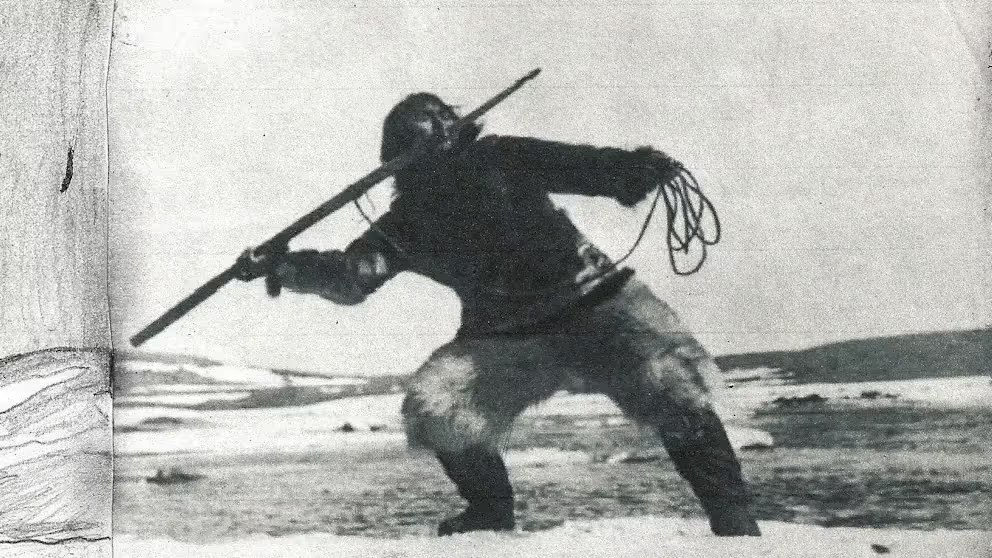
Introduction to Film Studies Lesson 10: Documentary
Part of the Introduction to Film Studies course.
⬅️Previous Lesson | Course Syllabus | Next Lesson ➡️
The Creative Treatment of Actuality
Introduction: The Fiction of Non-Fiction
We tend to divide cinema into two neat, opposing boxes: Fiction (made up) and Documentary (real).
This is a false dichotomy. It suggests that one is an art form (constructed) and the other is a window (transparent). But if you have been paying attention to the previous lessons on editing and framing, you know that a "transparent window" does not exist in cinema.
John Grierson, the father of the British documentary movement in the 1930s, famously defined documentary not as "truth," but as "The creative treatment of actuality."
Notice the word "Creative." Even in a documentary, there is a camera (which frames out parts of the room), an editor (who cuts out boring hours of life), and a director (who asks specific questions to get specific answers). A documentary is not reality; it is a representation of reality. It is a story constructed out of facts. In this lesson, we will explore how that construction happens, and the ethical landmines that explode when you turn real people into characters.
1. The Modes of Documentary
How does a documentary speak to us? Film theorist Bill Nichols identified distinct "Modes" of documentary. Understanding these helps us see how the truth is being packaged and sold to the viewer.
A. Expository Mode (The "Voice of God")
This is the classic format we associate with television news and history channels. An authoritative, invisible narrator explains the world to us while images illustrate what they are saying.
- The Logic: The image is secondary to the argument. The narrator holds the truth; the footage just proves it.
- Example: Planet Earth. We trust David Attenborough implicitly. When he tells us a leopard is hungry, we believe him, even though the footage might have been stitched together from three different days. The film presents itself as objective fact.
B. Observational Mode (The "Fly on the Wall")
Emerging in the 1960s with lighter, portable cameras, this mode tries to be invisible. There is no narration, no interviews, and no music. The camera simply watches events unfold without interfering.
- The Logic: If the filmmaker doesn't interact, the truth will reveal itself.
- Example: Grey Gardens (1975) or High School (1968). We feel like we are peeking through a window. However, we must remain skeptical: the Heisenberg Uncertainty Principle applies here. The presence of a camera changes how people behave. The subjects know they are being filmed, so they are performing a version of themselves.
C. Participatory Mode (The Provocateur)
The filmmaker is a character in the movie. They do not just observe; they provoke. The story is not just the subject; the story is the interaction between the filmmaker and the subject.
- Example: Michael Moore (Bowling for Columbine) or Louis Theroux. They use their own personality to prod subjects into revealing things they otherwise wouldn't. The "truth" here is found in the confrontation.
D. Reflexive Mode (The Mirror)
This is the most "Meta" mode. The film is about the process of making the film. It questions its own truthfulness.
- Example: Man with a Movie Camera (1929) or Stories We Tell (2012). These films show us the cameras, the sets, and the reenactments, constantly reminding us: "You are watching a movie. Do not trust this."
2. The Ethics of the Lens
Documentary filmmaking is an ethical minefield. When you film actors in a fiction movie, they are paid professionals protected by contracts and unions. When you film real people, you are capturing their actual lives, often during their most vulnerable moments.
The Power Imbalance
The director holds all the power. They decide what to include and what to cut. They can make a smart person look stupid by editing out the pause before they answer a question. They can make a kind person look angry by adding ominous music.
- Case Study: Tiger King (2020). The filmmakers turned eccentric real people into caricatures for our entertainment. While it was a hit, critics argued it was "poverty porn"—exploiting the messy lives of its subjects for memes rather than understanding.
Informed Consent
Does the subject truly understand how they will be portrayed? A subject might sign a release form thinking they are in a flattering biopic, only to realize at the premiere that they are the villain of the story. Is it ethical to lie to a subject to get to a "Greater Truth"?
Staging Reality
The first feature-length documentary in history, Nanook of the North (1922), is also the first lie. The director, Robert Flaherty, wanted to show the traditional life of the Inuit. But by 1922, the Inuit were already using guns and wearing modern clothes. Flaherty forced his subject, Nanook, to hunt with a spear (which he didn't know how to use) and wear traditional furs. He staged the "truth" to make it more cinematic. Does this make it a fake? Or does it capture a "cultural truth" that was fading away?
3. The Modern Blur: "Docufiction"
In recent years, the line between fiction and documentary has blurred completely. Directors are realizing that sometimes, you have to use the tools of fiction to reveal the psychological truth of a real event.
Consider Reenactments. In The Thin Blue Line (1988), Errol Morris used stylized, noir-like reenactments of a murder. Critics hated it at the time, calling it "Hollywood." But those reenactments helped visualize the inconsistencies in the police report, eventually leading to the innocent man's release from prison. The "fake" scenes led to real justice.
Even more radical is The Act of Killing (2012). The director asked real leaders of the Indonesian genocide to reenact their mass murders in the style of their favorite American movies (Westerns, Gangster films). The result is a fever dream of bright colors and bad acting. But in watching them play-act, we see the terrifying reality of their lack of remorse. We see how they have fictionalized their own memories to live with themselves. The artifice reveals the horror better than a standard interview ever could.
The Philosophical Horizon: Epistemology
Why does documentary matter to philosophy? Because it is a test of Epistemology—the study of knowledge. How do we know what we know?
When you watch the news or a documentary, you are implicitly entering a contract of trust. You are accepting the image as proof. You say, "I saw it with my own eyes."
But film theory teaches us that the camera is a liar.
- A lens choice can make a crowd look bigger or smaller.
- A slow-motion effect can make a police action look heroic or brutal.
- A sound edit can make a silence look like guilt.
In an era of "Fake News," AI-generated video, and Deepfakes, the "Indexical Quality" of the image (the link between the camera and reality) is broken. Documentary studies teach us to be skeptical of the image. It teaches us that there is no such thing as an "objective" view of the world. Every camera angle is a bias. Every edit is an opinion. Truth is not something you find in the world; it is something you make in the cutting room.
We must stop asking, "Is this video real?" and start asking, "Who made this video, and what do they want me to believe?"
The Seminar Room
Join the discussion below. (Note: You must be a logged-in member to comment.)
Today's Prompt: The Truth Test
Think of a documentary that changed your mind about a topic.
- The Film: (e.g., Blackfish or Making a Murderer).
- The Mode: Was it a "Voice of God" telling you facts, or a "Fly on the Wall" showing you emotion?
- The Skepticism: Look back at it now. Did the music tell you how to feel? Did the editing leave out the other side's argument?
Continue the course
➡️ Next lesson: Genre
Discussion
Use the comments below to ask questions, raise objections, or test ideas from this lesson.
⬅️Previous Lesson | Course Syllabus | Next Lesson ➡️