Introduction to Film Studies 11: Genre
Introduction to Film Studies Lesson 11: Genre
Part of the Introduction to Film Studies course.
⬅️Previous Lesson | Course Syllabus | Next Lesson ➡️
The Rituals of Storytelling
Introduction: The Contract of Expectation
When you walk into a library, you don't just look for "a book." You look for a specific experience. You want the intellectual puzzle of a Mystery, the visceral adrenaline of a Thriller, or the emotional catharsis of a Romance.
In cinema, we call these categories Genres (from the French word for "Type" or "Kind").
To the uninitiated, genre is often dismissed as a commercial formula—a lazy way for Hollywood studios to package and sell the same product repeatedly. Critics might say, "If you've seen one Rom-Com, you've seen them all." But to the film student, genre is something far more profound. It is a psychological contract between the filmmaker and the audience.
This contract creates a specific set of expectations. If we see a spaceship on a poster, we expect aliens and technology. If we see a trench coat and a rainy street, we expect a crime and a moral dilemma. We find comfort in these stories not because they are new, but because they are familiar. They are the modern equivalent of ancient folk tales. We know the hero will survive, the couple will kiss, and the monster will be defeated. In a chaotic and unpredictable world, genre provides the comforting architecture of order.
However, genre is not just about comfort; it is a language. By establishing a set of rules, the director can communicate complex ideas instantly. Because we know the rules, we can focus on how they are being broken.
1. Iconography: The Visual Shorthand
Every genre speaks its own visual language. We call these repeated visual symbols Iconography.
In a film, an object is rarely just an object. In the context of a genre, an object becomes a symbol charged with history and meaning.
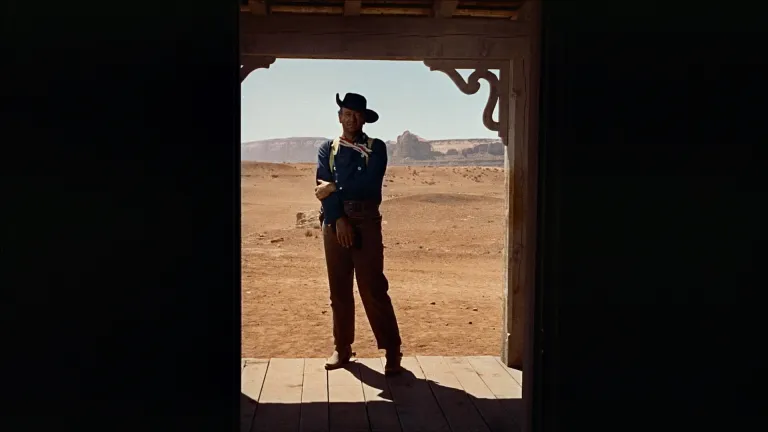
- The Western: The iconography includes the revolver, the horse, the saloon doors, the sheriff's star, and the vast, empty desert. These icons function as a shorthand for the conflict between "The Garden" (Civilization/Law) and "The Wilderness" (Savagery/Freedom).
- Film Noir: The iconography includes Venetian blinds (slicing people into prison-like shadows), cigarette smoke, wet pavement, and the fedora. These icons signal a world of moral ambiguity, deception, and entrapment.
- Science Fiction: The iconography includes chrome surfaces, lasers, sterile white corridors, and robotics. These icons represent the promise—and the threat—of human advancement.
Directors rely on this visual shorthand to bypass exposition. When George Lucas made Star Wars in 1977, he was creating a space opera, but he borrowed the iconography of the Western. He strapped a low-slung gun holster to Han Solo’s leg and placed him in a dusty cantina. Instantly, without a single line of dialogue, the audience recognized the archetype: Han Solo was a Gunslinger. We transferred seventy years of Western history onto a sci-fi character in a single glance. This is the efficiency of genre.
2. The Life Cycle of a Genre: A Case Study
Genres are not static statues in a museum; they are living organisms that grow, age, mutate, and eventually die. Film historians have observed that almost every major genre—from the Western to the Musical to the Superhero movie—follows the same four-stage lifecycle.
To understand this, let us track the Western, the most durable genre in American history.
Stage 1: The Primitive (The Birth) The genre is new. The conventions are being established for the first time. The films are emotionally powerful but often simplistic in their morality.
- Example: The Great Train Robbery (1903). This short film established the basic grammar: the outlaw, the posse, the shootout. It was raw and direct.
Stage 2: The Classical (The Peak) The rules are set. The genre is confident, balanced, and reflects the dominant values of the society that produced it. The audience knows exactly who to root for.
- Example: Stagecoach (1939) or Shane (1953). In the Classical Western, the hero is a stoic man of honor. He protects the weak. The "Savage" (often portrayed by Native Americans in racist caricatures) is defeated, and "Civilization" (the white settlers) is saved. The film acts as a myth to reassure America that its history was noble and necessary.
Stage 3: The Revisionist (The Critique) Society changes. The values of the audience shift, and the old myths stop working. Filmmakers begin to use the genre to critique itself. They take the icons we love and invert them to expose the dark underbelly of the myth.
- Example: The Searchers (1956) and The Wild Bunch (1969). By the late 60s, America was torn apart by the Vietnam War and the Civil Rights movement. The idea of "manifest destiny" and "noble violence" no longer felt true.
- In the Revisionist Western, the cowboys are not heroes; they are violent alcoholics or mercenaries. The "Civilization" they protect is corrupt. The Native Americans are shown as victims of genocide rather than villains. The film asks a devastating question: Was the Classical myth a lie?
Stage 4: The Parodic (The Death) The genre becomes so exhausted that the clichés can only be used for comedy. The symbols lose their power and become jokes.
- Example: Blazing Saddles (1974). Once a genre hits this stage, it usually goes dormant for a decade or two until a filmmaker reinvents it (as the Superhero genre is currently experiencing with Deadpool).
3. Social Function: The Cultural Mirror
Why do we watch the same stories for decades? We do it because genres function as cultural pressure valves. They address specific societal anxieties that we cannot discuss openly.
The Horror Film: The Return of the Repressed Horror is rarely just about a monster. It is about the "Return of the Repressed"—the specific fears that a society tries to ignore.
- The 1950s: American horror was dominated by giant ants (Them!) and alien invaders (The Thing). This was not about biology; it was about the Cold War. The giant bugs represented the fear of the Atomic Bomb; the body-snatching aliens represented the fear of Communist infiltration.
- The 1980s: The focus shifted to the "Slasher" (Friday the 13th, Halloween). These films almost always featured a faceless killer punishing sexually active teenagers. This reflected the conservative backlash to the sexual revolution and the rising fear of the HIV/AIDS crisis. The "Monster" had moved from the sky (The Bomb) to the bedroom (Sex).
The Sci-Fi Film: The Fear of Ourselves If the Western is about the past, Sci-Fi is about the future. It allows us to play out the consequences of our current behavior.
- Godzilla (1954) is a metaphor for the trauma of Hiroshima.
- The Matrix (1999) is a metaphor for the fear of the Internet and the loss of reality in the digital age.
- Ex Machina (2014) is a metaphor for the fear of Artificial Intelligence and gender dynamics.
The Philosophical Horizon: Ideology and Myth
This is where Film Studies meets Philosophy. Genre is the clearest place to see Ideology at work.
The French theorist Roland Barthes argued that modern societies create "Myths" just like ancient ones. These myths transform "History" (which is messy and complex) into "Nature" (which feels simple and inevitable).
Genre films are the primary delivery system for these myths.
- The Romantic Comedy reinforces the ideology of Monogamy and Heteronormativity. It tells us that happiness is impossible without marriage, and that men and women are fundamentally different species who must learn to "speak" to each other.
- The Action Movie reinforces the ideology of Violence. It suggests that the world is divided into Good and Evil, and that the only way to resolve conflict is through physical force. It comforts us with the lie that problems can be solved by shooting the bad guy.
When we study genre, we are not just studying movies; we are studying the subconscious of a civilization. We are asking: What lies does this society tell itself to feel safe? And, perhaps more importantly, when those genres shift (as they are doing now), we can see that the society is beginning to tell itself a new story.
The Seminar Room
Join the discussion below. (Note: You must be a logged-in member to comment.)
Today's Prompt: The Genre Bender Pick a film that looks like one genre but acts like another (a "Hybrid" or "Revisionist" film).
- The Film: (e.g., Alien).
- The Mix: Is it a Sci-Fi? Or is it actually a Haunted House movie in space?
- The Evidence: What icons belong to Sci-Fi (spaceships, androids), and what plot points belong to Horror (the jump scare, the final girl)?
Continue the course
➡️ Next lesson: Ideology
Discussion
Use the comments below to ask questions, raise objections, or test ideas from this lesson.
⬅️Previous Lesson | Course Syllabus | Next Lesson ➡️