Introduction to Film Studies 12: Ideology
Introduction to Film Studies Lesson 12: Ideology
Part of the Introduction to Film Studies course.
⬅️Previous Lesson | Course Syllabus | Next Lesson ➡️
The Politics of the Image
Introduction: "It’s Just a Movie"
The most common defense of cinema—and the most dangerous one—is the phrase, "Relax, it’s just a movie. It’s not political."
Film Theory argues that this statement is impossible. No film is "just a movie." Every cultural object is a product of the society that made it. It inevitably carries the beliefs, biases, values, and blind spots of that society—whether the director intended to or not.
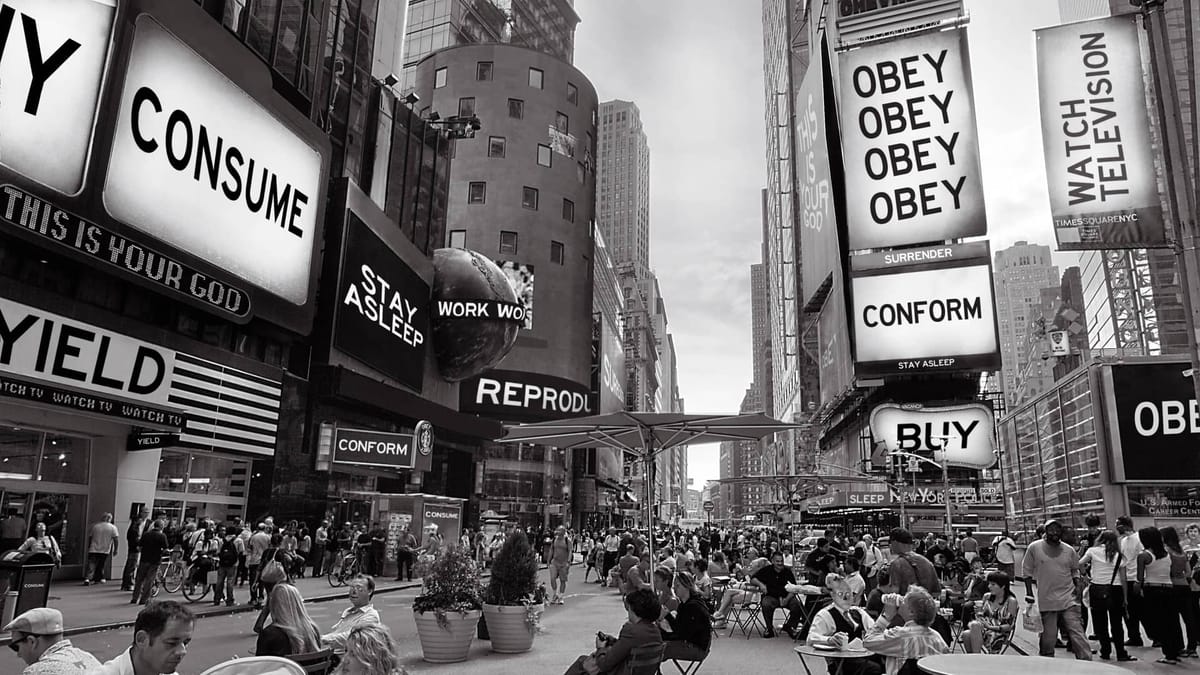
This invisible baggage is what we call Ideology.
In common usage, "ideology" often means political propaganda (like Fascism or Communism). But in cultural studies, it means something broader and more subtle. Ideology is the "System of Ideas" that we accept as "natural" or "common sense."
- It is "common sense" in a Romantic Comedy that the woman’s ultimate goal is to get married.
- It is "common sense" in a Police Procedural that the legal system works and that criminals are bad people who need to be punished.
When a film reinforces these beliefs, it is performing Ideological Work. It is comforting the audience by telling them: "This is how the world is, and this is how it should be." The danger of cinema is not that it lies to us, but that it makes its lies look like nature.
1. The Explicit vs. The Implicit
When analyzing the politics of a film, we distinguish between two levels of messaging.
A. Explicit Ideology The film shouts its message. It is trying to persuade you of a specific point of view.
- Example: Do The Right Thing (1989). Spike Lee explicitly creates a dialectic about race relations, police brutality, and the conflicting philosophies of Dr. King and Malcolm X. The film wants you to argue about it.
- Example: Top Gun (1986). This film was produced with the cooperation of the US Navy. It is explicitly designed to show the excellence of the American military. It functions, quite literally, as a recruitment poster.
B. Implicit Ideology This is much more common and much more powerful. The film claims to be "neutral" entertainment, but it quietly smuggles in a worldview.
- Example: The Disney Princess. For decades, films like Sleeping Beauty or Cinderella were marketed as innocent fairy tales about magic. But implicitly, they taught millions of children a specific ideological lesson about Gender: Men are active (they fight dragons, they kiss); Women are passive (they sleep, they wait). The lesson was that a woman’s value lies in her beauty, and her salvation lies in a man. The audience absorbs this lesson not because they are studying it, but precisely because they aren't studying it. They are just "being entertained."
2. Representation and "The Other"
The most visible battleground of ideology is Representation. Who gets to be the Subject (the Hero), and who is relegated to the Object (the Villain, the Sidekick, the Victim)?
Cinema has a long history of defining "The Norm" as white, male, Western, and heterosexual. Everyone else is defined as "The Other."
The cultural theorist Edward Said coined the term Orientalism to describe how Western art (including cinema) depicts the East. In films like Indiana Jones or The Mummy, the "East" is shown as exotic, dangerous, magical, and backward. The "West" (Harrison Ford) is shown as rational, scientific, and civilized. This isn't just an adventure story; it is an ideological justification for Colonialism. It suggests that the East needs to be managed by the West.
Stereotypes as Control Stereotypes are not just lazy writing; they are tools of social control. By reducing a complex human being to a single trait, the film strips them of power.
- The Magical Negro: A black character who has no interior life of their own but exists solely to help the white protagonist learn a lesson (e.g., The Green Mile, The Legend of Bagger Vance).
- The Smurfette Principle: A group of male characters has distinct personalities (The Brainy One, The Strong One, The Funny One), while the single female character has only one personality trait: "The Girl."
3. Case Study: The 80s Action Hero
Let’s look at the ideology of the 1980s American Action Movie (e.g., Rambo II, Commando, Die Hard).
The Context: In the 1970s, America lost the Vietnam War. The national ego was bruised. The economy was in recession. The dominant feeling was one of weakness and confusion.
The Content: Hollywood responded with a wave of films featuring hyper-masculine, incredibly muscular men (Stallone, Schwarzenegger) going back to the jungle to win the war single-handedly.
The Ideology: These films were a fantasy of Revisionist History. They were designed to heal the American psyche. They told the audience: "We didn't lose Vietnam because we were weak; we lost because bureaucrats and politicians held us back. If we just unleash our raw strength, we can conquer anything." Rambo is not just an action figure; he is a political argument. He represents a rejection of diplomacy and a celebration of unilateral force. The explosions were not just entertainment; they were political therapy for a wounded superpower.
The Philosophical Horizon: Hegemony
Why does this matter? Because of Hegemony.
The Italian philosopher Antonio Gramsci, writing from a fascist prison cell in the 1930s, asked a simple question: Why do the oppressed accept their oppression? Why don't the workers just revolt?
He argued that ruling classes don't just rule by Coercion (police, armies, prisons); they rule by Consent. They control the culture. They control the stories, the songs, the schools, and the movies. By controlling the culture, they control "Common Sense."
If you can convince the poor that the rich "worked harder" to get their money (as many movies imply), the poor will not revolt; they will try to become rich. This is called Cultural Hegemony.
Cinema is the most powerful machine for manufacturing consent ever invented. When we critique the ideology of a film, we are engaging in Counter-Hegemony. We are refusing to blindly accept the worldview the film is selling. We are asking: Who benefits from this story?
- Does this Rom-Com benefit women, or does it benefit the institution of marriage?
- Does this Cop Movie benefit the community, or does it benefit the state?
Cinema is a dream machine, but we must always ask: Whose dream are we dreaming?
The Seminar Room
Join the discussion below. (Note: You must be a logged-in member to comment.)
Today's Prompt: The Hidden Message Pick a "mindless" popcorn movie you love (a comedy, superhero movie, or action flick).
- The Film: (e.g., The Avengers).
- The Assumption: What does the film assume is "normal"? (e.g., That the world is best saved by a small group of unaccountable, powerful individuals rather than by democratic governments).
- The Verdict: Is this ideology dangerous, or is it harmless fun?
Complete the course
➡️ Final Lesson: Synthesis
Discussion
Use the comments below to ask questions, raise objections, or test ideas from this lesson.
⬅️Previous Lesson | Course Syllabus | Next Lesson ➡️