Introduction to Film Studies 4: Mise-en-scène
Introduction to Film Studies Lesson 4: Mise-en-scène
Part of the Introduction to Film Studies course.
⬅️Previous Lesson | Course Syllabus | Next Lesson ➡️
The Psychology of the Room
Prerequisite: Lesson 3: The Principles of Form
Introduction: The Director as Architect
In the previous lesson, we analyzed the abstract rules of Form and Narrative. Now, we turn our attention to the concrete physical reality of the movie.
Before a director can yell "Action," they must first build a world. They have to paint the walls, choose the furniture, dress the actors, and decide exactly where the shadows will fall. This is Mise-en-scène (pronounced meez-ahn-sen). It is a French theatrical term meaning "putting into the scene."
If Cinematography is how we see (the lens, the angle, the focus), then Mise-en-scène is what we see. It encompasses everything that appears in front of the camera: setting, props, costume, lighting, and staging.
To the casual viewer, the setting of a film is just a background—a container where the action happens. But to the film student, the setting is an external expression of an internal state. A messy room tells us a character is chaotic; a sterile room tells us they are repressed. The director controls the environment to control the audience's emotion.
1. Setting and Props: The External Soul
Filmmakers generally choose between two approaches to setting: shooting On Location (to achieve the gritty texture of Realism) or shooting on a Soundstage (to achieve the total control of Formalism).
Regardless of the choice, the set functions as a map of the character's psychology. Consider the mansion, Xanadu, in Orson Welles' Citizen Kane (1941). It is a cavernous, cathedral-like space filled with thousands of crates, statues, and expensive junk. The Mise-en-scène here is "cluttered." This is not just decoration; it symbolizes Kane’s spiritual condition. He is a man who has replaced human connection with material possession. He is trying to fill the emotional void in his soul with objects. The room looks full, but the scale makes it feel empty and lonely. The prop becomes a symbol of the man.
2. Costume and Makeup: Identity
In a novel, an author can spend three pages describing a character's personality and history. In film, the director has about three seconds to convey that same information. Costume is the shorthand for identity.
We can often track a character’s entire narrative arc simply by looking at their clothes. In The Godfather, Michael Corleone begins the film wearing an Ivy League military uniform and brown corduroys. The textures are soft; the colors are earthy. He is visually coded as a civilian, an innocent, and an outsider to the family business.
By the end of the film, he wears sharp, expensive, three-piece black suits with a fedora. The lines are hard; the colors are severe. Without a single line of dialogue, the Mise-en-scène of his wardrobe tells us that he has hardened. He has shed his individuality to become the "Don."
3. Lighting: Painting with Shadow
Of all the tools in the director's kit, Lighting is arguably the most powerful for manipulating mood. Classic Hollywood cinema relies on the Three-Point System (Key, Fill, and Backlights) to model actors attractively. However, the ratio between these lights defines the genre.
Comedies and Musicals use High-Key Lighting. The scene is flooded with light (high Fill), minimizing shadows and creating a sense of safety, optimism, and clarity. Everything is visible; nothing is hidden.
Conversely, Film Noir and Horror use Low-Key Lighting (often called Chiaroscuro). This creates deep blacks and sharp contrasts, obscuring the characters' eyes and hiding danger in the corners. In Apocalypse Now, Marlon Brando’s character, Colonel Kurtz, is lit almost entirely in shadow. We rarely see his full face; we only see fragments of his bald head emerging from the blackness. The lighting tells us he is a man who has been physically and morally swallowed by the darkness.
4. Staging and Proxemics
Finally, we look at the actors themselves. Staging (or Blocking) refers to the movement and placement of figures in the frame.
This relies on the concept of Proxemics—the spatial relationships between bodies. In our culture, distance equals relationship.
- Intimate Distance (0–18 inches): Lovers or fighters.
- Personal Distance (1.5–4 feet): Friends.
- Social Distance (4–12 feet): Business.
A director can create tension by violating these zones. If a villain steps into a hero's "Intimate Zone" without permission, it creates an immediate physical threat. Furthermore, the vertical placement matters. A character standing up dominates a character sitting down. A character in the foreground dominates a character in the background. The director choreographs this dance to show us who has the power in the scene, even if they aren't speaking.
The Philosophical Horizon: Phenomenology
Why does Mise-en-scène matter to philosophy? It connects to Phenomenology—the study of experience and consciousness.
Philosophers like Maurice Merleau-Ponty argued that we don't just "think" about the world; we "inhabit" it. Our physical environment shapes our consciousness. You feel different in a cathedral than you do in a subway station; your thoughts change, your posture changes, your sense of "self" changes.
When a director constructs a claustrophobic set—like the spaceship in Alien or the submarine in Das Boot—they are not just showing you a room; they are forcing you to have a phenomenological experience of confinement. They are manipulating your physical sense of "Being-in-the-World." By controlling the space, they control the mind.
The Seminar Room
Join the discussion below. (Note: You must be a logged-in member to comment.)
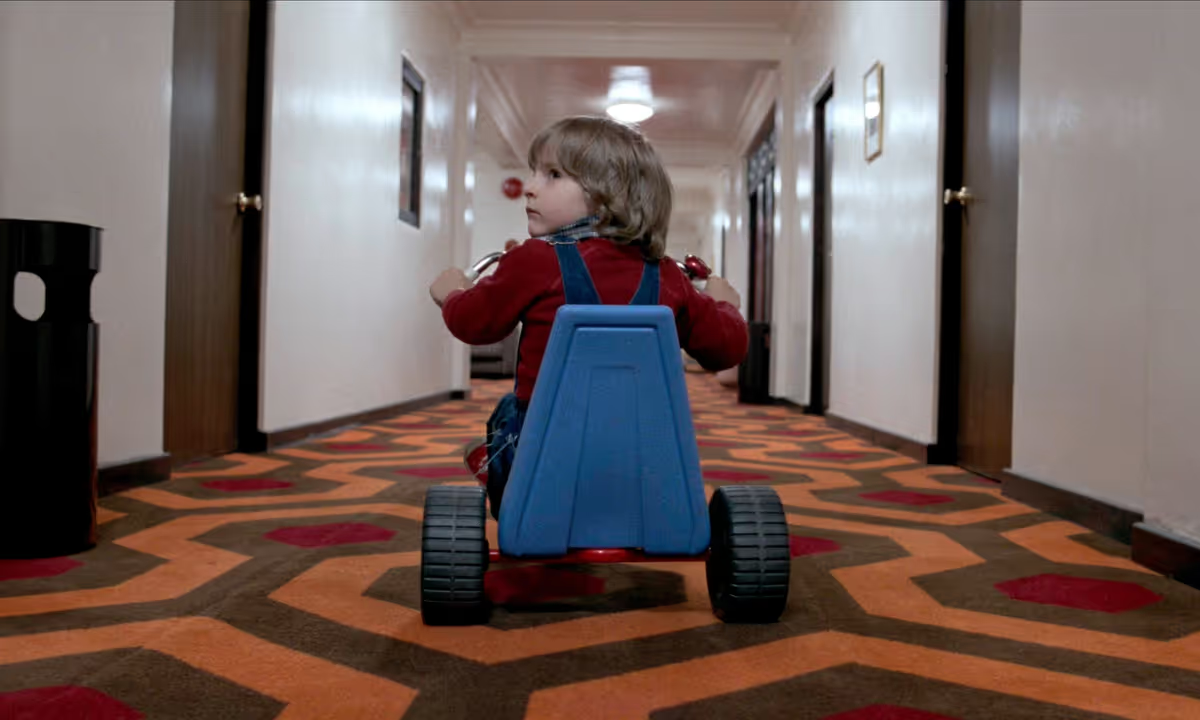
Today's Prompt: The Environmental Detective Pick a film where the Setting acts like a villain or a hero.
- The Film: (e.g., The Shining).
- The Element: The Overlook Hotel.
- The Analysis: How does the geometry of the hotel (endless corridors, impossible layouts) create the horror? Is the hotel a place, or is it a character?
Continue the course
➡️ Next lesson: Cinematography
Discussion
Use the comments below to ask questions, raise objections, or test ideas from this lesson.
⬅️Previous Lesson | Course Syllabus | Next Lesson ➡️