Introduction to Film Studies 9: Realism vs. Formalism
Introduction to Film Studies Lesson 9: Realism vs. Formalism
Part of the Introduction to Film Studies course.
⬅️Previous Lesson | Course Syllabus | Next Lesson ➡️
The Hidden Narrative
Introduction: The Window vs. The Frame
Every filmmaker must answer one philosophical question before they pick up a camera: What is the purpose of cinema?
Is the camera a scientific instrument designed to capture the world exactly as it is? Or is the camera a paintbrush designed to change, interpret, and express the world?
This debate is the central nervous system of film theory. It creates a spectrum with two opposing poles:
- Realism (The Window): The filmmaker tries to hide their interference. The screen is a transparent window into reality. The goal is to reveal the world, preserving its ambiguity and complexity.
- Formalism (The Frame): The filmmaker emphasizes their interference. The screen is a canvas for the artist's vision. The goal is to express a feeling or an idea, often by distorting reality.
Most films fall somewhere in the middle, but to understand cinema, you must understand the extremes.
1. The Origin Story: Lumière vs. Méliès
This rivalry is not a modern invention; it began in the very first years of cinema (1895–1902) with two French pioneers who hated each other’s methods.
The Realists: The Lumière Brothers Auguste and Louis Lumière were scientists, not artists. They invented the Cinématographe to document reality. Their first films were simple 50-second clips called "Actualities": Workers Leaving a Factory, The Baby’s Breakfast, or Arrival of a Train. They did not use actors, scripts, sets, or costumes. They simply placed the camera on a tripod and let the world happen in front of it. To them, the beauty of cinema was in the random movement of leaves in the wind, the texture of smoke, and the unscripted chaos of a street. They believed the camera was a machine for preservation.
The Formalist: Georges Méliès Méliès was a stage magician who bought a camera. He wasn't interested in reality; he found reality boring. He realized that if he stopped the camera, moved an object, and started recording again, he could make people "disappear." He built the world’s first film studio (a greenhouse with movable sets) and created A Trip to the Moon (1902). This film was full of painted backdrops, elaborate costumes, dancers, and impossible physics. He invented special effects. To Méliès, the camera was a machine for Spectacle.
Every film you watch today is a descendant of one of these two fathers. Documentaries and Indie Dramas are the children of Lumière. Marvel movies, Sci-Fi, and Musicals are the children of Méliès.
2. The Realist Tradition: The Morality of the Long Take
Realism is often misunderstood as just "handheld cameras and bad lighting." But true Realism is a philosophical stance.
The Philosophy: "Let reality speak." The champion of this view was the French critic André Bazin. Bazin believed that the camera had a moral obligation to respect the integrity of space and time. He hated "Montage" (cutting) because he felt it manipulated the audience. When a director cuts from a face to a gun, they are forcing you to make a connection. Bazin called this authoritarian.
Instead, Bazin championed the Long Take and Deep Focus.
- The Long Take: Letting the camera run for minutes without cutting.
- Deep Focus: Keeping everything from the foreground to the background in sharp focus.
Bazin argued that this style was Democratic. It allows the viewer's eye to wander the frame and find the truth for themselves. It preserves the ambiguity of reality.
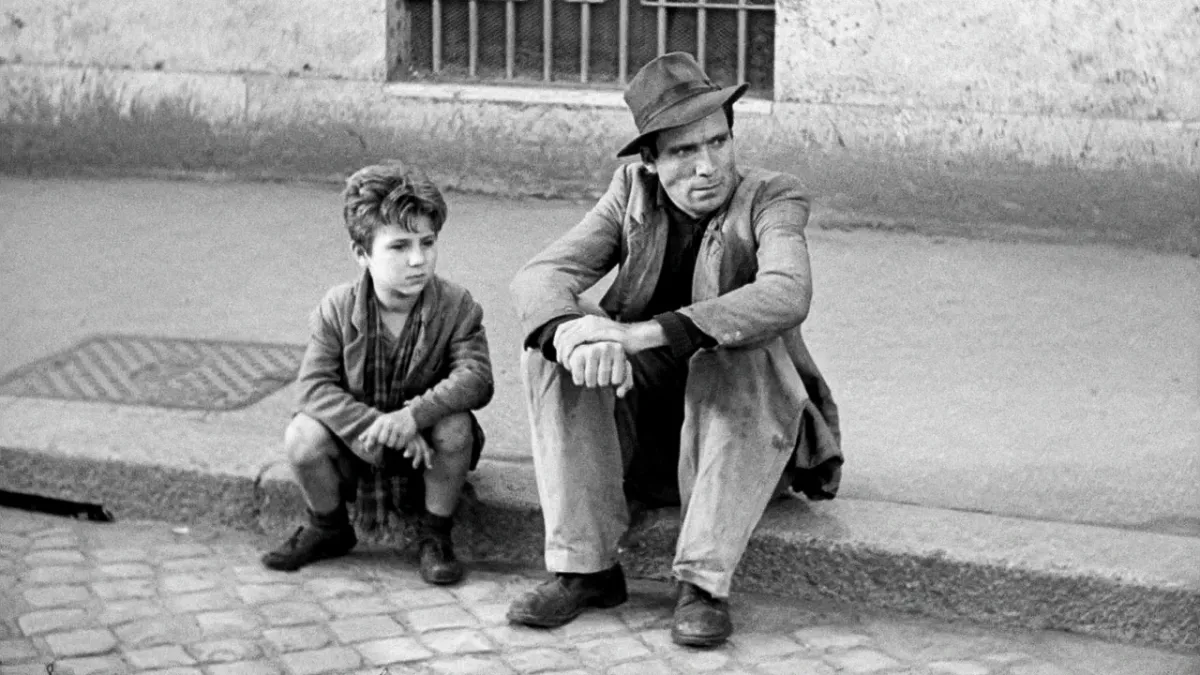
Key Movement: Italian Neorealism (1940s) After WWII, Italy was in ruins. The massive studios were bombed out, so directors like Vittorio De Sica and Roberto Rossellini took their cameras into the streets. They couldn't afford stars, so they hired non-actors. In Bicycle Thieves (1948), the plot is simple: a man needs his stolen bike back to keep his job. But the style is revolutionary. The camera lingers on the textures of the crumbling walls, the rain-soaked streets, and the tired faces of the crowd. The tragedy isn't scripted; it feels like we are witnessing a random, cruel event in a ruined city. The film doesn't tell you how to feel; it just shows you the suffering and lets you decide.
3. The Formalist Tradition: The Psychology of Montage
On the other side of the spectrum, Formalists believe that "Realism" is a lie. A movie is never real. Even a documentary is framed, edited, and color-graded. Therefore, the artist should embrace the manipulation.
The Philosophy: "Reality is raw material; Art is the construction." The champion of this view was the Soviet director Sergei Eisenstein. Eisenstein believed that art was about Conflict. He argued that the director should grab the audience by the throat and force them to feel a specific emotion.
He championed Montage (the collision of shots). He didn't want a "Democratic" viewer; he wanted a viewer who was emotionally guided by the director.
- Example: In Battleship Potemkin, Eisenstein edits the sequence of the "Odessa Steps" so rhythmically and violently that the audience physically feels the terror of the massacre. He stretches time, repeats shots, and juxtaposes images (a stone lion "waking up") to create a metaphor. He isn't recording the event; he is constructing the horror.
Key Techniques:
- Expressionism: Using shadows and colors that don't exist in nature to express internal psychology. In The Cabinet of Dr. Caligari, the sets are jagged and painted with sharp angles to represent the madness of the narrator. The world looks crazy because the character is crazy.
- Distortion: Using wide-angle lenses (like in The Favourite) or slow motion to warp reality.
4. The Spectrum: Classical Cinema
In practice, pure Realism (a security camera feed) is boring, and pure Formalism (abstract shapes dancing) is confusing.
90% of commercial movies sit in the middle. We call this Classical Cinema (or Classical Hollywood).
- The Illusion: It looks real enough to be believable (Realism).
- The Manipulation: But the lighting is attractive, the music swells at the right time, and the bad guy dies at the end (Formalism).
Classical Cinema is essentially Formalism disguised as Realism. It uses the tools of Méliès (sets, scripts, lighting) to create a world that feels like Lumière's. Consider Casablanca. It feels "real"—the emotions work, the politics are serious. But look closer: the "Paris" flashback is a painted set; the fog is dry ice; the lighting on Ingrid Bergman creates a halo that doesn't exist in nature. It is a completely artificial world designed to make you cry.
The Philosophical Horizon: The Digital Lie
Why does this debate matter in the 21st century? Because we are currently witnessing the death of Realism.
For the first 100 years of cinema, the camera had an Indexical relationship with reality. If you saw a picture of a man on a mountain, it meant that a real man actually stood on a real mountain. The light bounced off him and hit the film strip. There was a physical link to the truth.
In the age of CGI, Deepfakes, and AI, that link is broken. When we watch The Avengers, the man is not on a mountain; he is in a green room in Atlanta. Or perhaps he isn't there at all—he is a digital puppet.
The philosopher Jean Baudrillard argued that we now live in a state of Hyperreality, where the simulation is more "real" than the reality. We prefer the fake explosion because it looks better than a real one. We prefer the Photoshop face because it looks better than a real face.
As film students, we must ask: When the image is no longer proof of anything, what happens to the truth? Are we returning to the age of Méliès, where everything is a fantasy? And if cinema stops trying to show us reality, will we forget what reality looks like?
The Seminar Room
Join the discussion below. (Note: You must be a logged-in member to comment.)
Today's Prompt: The Reality Check Think of a film that felt incredibly "real" to you.
- The Film: (e.g., The Florida Project or The Blair Witch Project).
- The Technique: How did they do it? Did they use handheld cameras? Bad lighting? Unknown actors?
- The Verdict: Was it actually "real," or was that just a specific "style" of messiness used to manipulate you?
Continue the course
➡️ Next lesson: Documentary
Discussion
Use the comments below to ask questions, raise objections, or test ideas from this lesson.
⬅️Previous Lesson | Course Syllabus | Next Lesson ➡️