Shadows of the State: The Philosophy of The Conformist
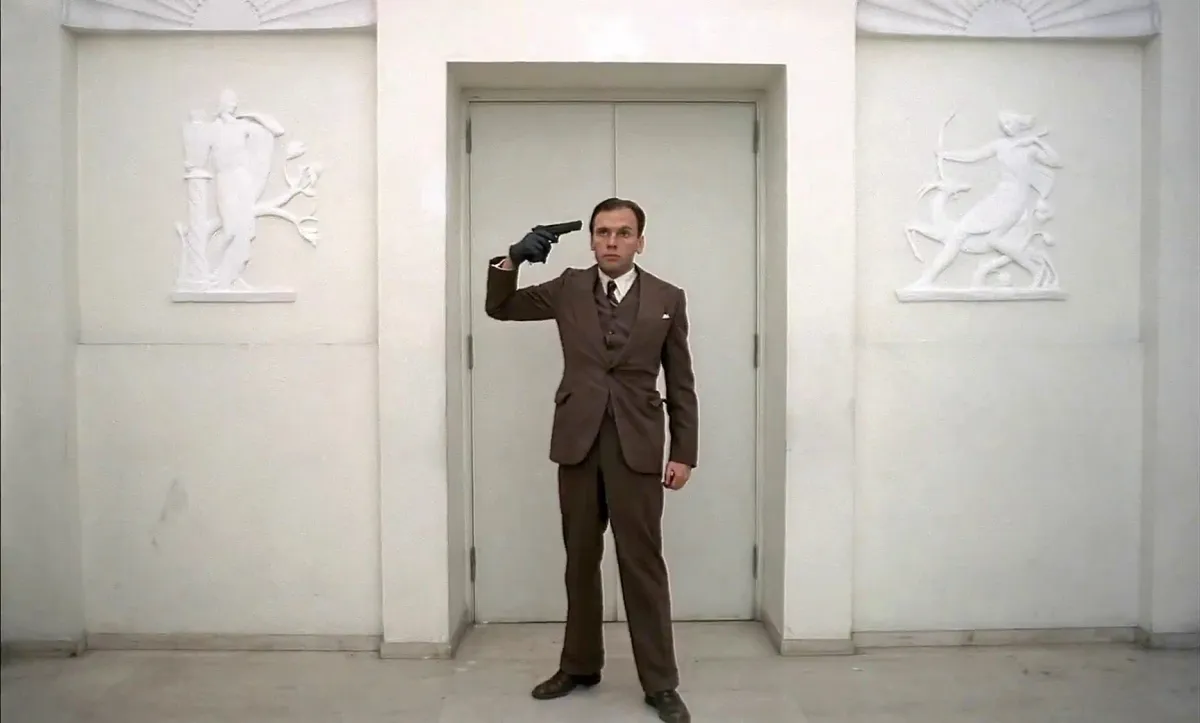
Introduction: The Desire for Normality
What does it mean to be "normal"? In a sane world, normality implies a balance, a healthy integration with one’s community. But what happens when the world itself goes mad? In Bernardo Bertolucci’s masterpiece The Conformist (Il Conformista, 1970), "normality" is not a sanctuary – it is a prison built from fear.
Marcello Clerici (Jean-Louis Trintignant) is a man so terrified of his own shadow – and the latent "deviance" of his own soul – that he is willing to cast the entire world into darkness just to belong. He doesn't join the Fascists because he believes in their ideology; he joins them because he is desperate to disappear into the crowd.
To understand Marcello, we must look beyond psychology and into the deepest roots of Western thought. Bertolucci’s film is not merely a period piece or a stylistic exercise; it is a moving text of political philosophy. It explicitly visualizes Plato’s Allegory of the Cave to demonstrate how a man can hollow himself out until nothing remains but the perfect, terrible shape of a conformist.
Part I: The Cinema as Plato’s Cave
At the heart of The Conformist lies a direct confrontation with philosophy. In the film's central set-piece, Marcello visits his former professor, Quadri, an anti-fascist intellectual now living in exile in Paris. This reunion is not just a plot point; it is a literal re-enactment of Plato's famous allegory.
In Plato's Republic, we are invited to imagine humanity as prisoners chained in a cave since birth. They face a blank wall, unable to turn their heads. Behind them burns a fire, and between the fire and the prisoners runs a road where men carry artifacts. The prisoners see only the shadows of these objects cast on the wall, mistaking these shadows for the whole of reality.
Bertolucci translates this metaphysical myth into cinematic action. As Marcello recounts Quadri’s old lectures, he stands in the professor's study and closes the shutters, throwing half the room into darkness. When Quadri asks what the prisoners see, Marcello replies: "They see only the shadows that fire makes on the back of the cave".
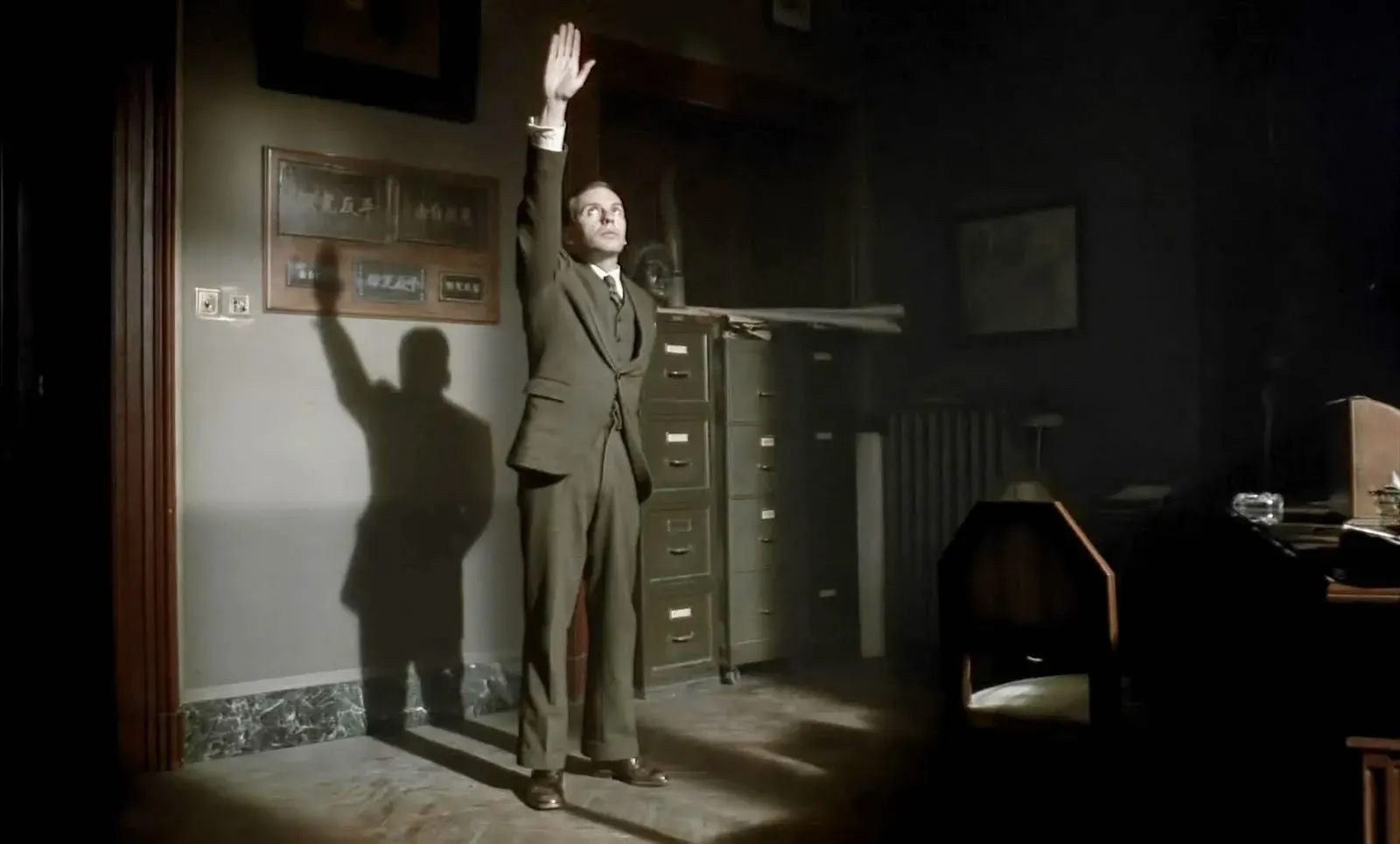
The visual direction here is devastating. As Marcello gestures to illustrate the "wall" of the cave, his own shadow is cast against the study wall. The silhouette of his arm forms a distinct, undeniable Fascist salute. When Quadri opens the shutters at the end of the scene, light floods the room, vanquishing Marcello’s shadow. But Marcello ultimately rejects this light. He is the prisoner who, dazzled by the sun, retreats back to the comfort of the darkness, terrified of the truth it reveals.
Visual Analysis: The Cinema as Cave
In this original video essay by Film & Philosophy, we break down the visual architecture of the "Cave Scene" and how Bertolucci uses light to construct Marcello's prison.
Bertolucci's Cave: A Platonic Reading of The Conformist
(Note: This video features narration from Orson Welles reading Plato’s Republic, overlaid with Bertolucci’s imagery to highlight the direct visual parallels.)
The Apparatus of Control
Bertolucci is doing more than referencing a classic text; he is updating and commenting upon it. In Plato’s version, the shadows are cast by a fire and a road hidden behind the prisoners. This setup is what philosopher Jean-Louis Baudry called the "cinematic apparatus" – the hidden machinery (projector, film strip, dark room) that creates the illusion of reality.
For Bertolucci, this apparatus is political. The "fire" and the "road" represent what Louis Althusser termed the Ideological State Apparatus – the schools, the media, and the culture that the state uses to manipulate the way citizens see the world. Marcello is not just a prisoner who can't see the light; he is a man who chooses the cave. He prefers the safety of the shadows because the light of self-reflection is too painful to bear.
When Quadri opens the shutters at the end of the scene, light floods the room, vanquishing Marcello’s shadow. But Marcello rejects this enlightenment. He is the prisoner who, dazzled by the sun, retreats back to the comfort of the darkness, terrified of the truth it reveals.
Part II: The Architecture of the Soul
If the cave is the metaphysical state of the conformist, the visual style of the film is the psychological cage. Plato argued that the state is "the individual writ large" – that the structure of a society mirrors the structure of the human soul. He divided the soul into three parts: Reason, Spirit, and Appetite.
In a just individual, these three parts are in harmony, governed by Reason. But in The Conformist, Bertolucci presents us with a fractured, unbalanced soul, personified by the three characters traveling together from Rome to Paris.
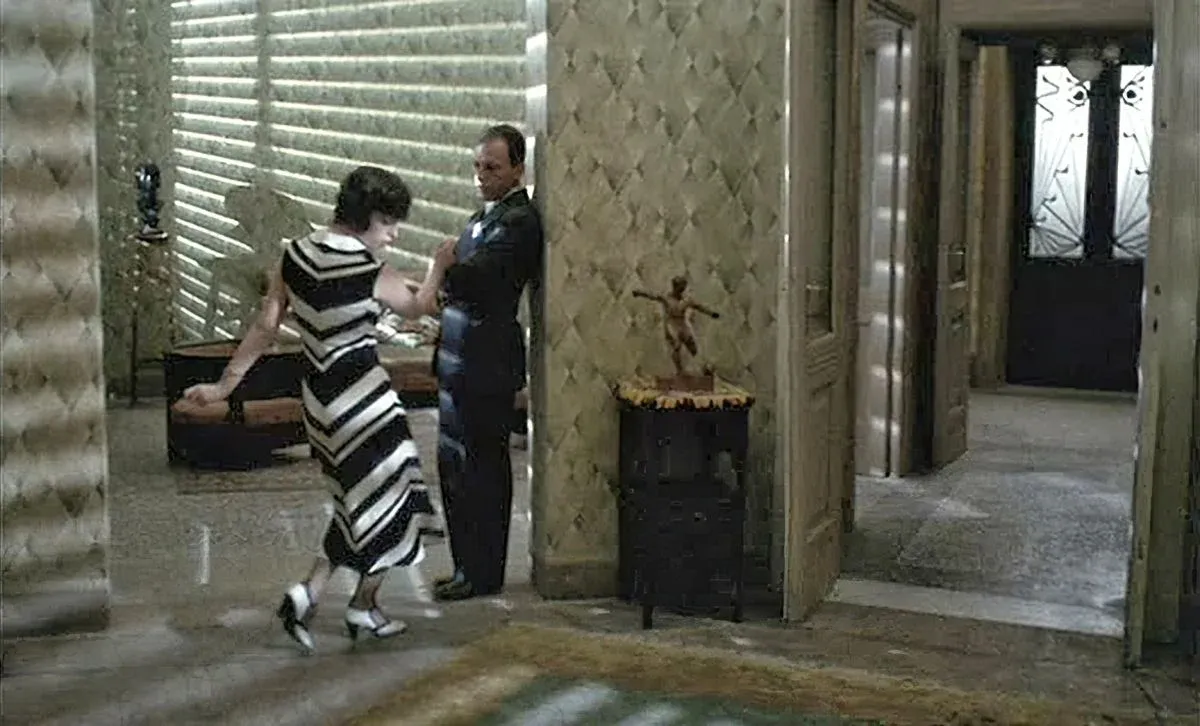
1. Appetite: Giulia Marcello’s fiancée, Giulia, is pure Appetite. She is consistently framed in relation to the sensory world – she is eating, dancing, or discussing domestic trivialities. In one of the film's most visually striking scenes, she stands in her apartment while Venetian blinds cast bar-like shadows across her dress, which itself features a zig-zag "dazzle" pattern. She blends into the chaotic interplay of light and dark, consumed by her environment. She represents the "blindness" of the bourgeoise, happy in her ignorance, described by Marcello as "mediocre... a mound of petty ideas".
2. Spirit: Manganiello The secret police agent, Manganiello, embodies the "Spirit" (or thumos). He is the unthinking muscle of the state, motivated by a love of victory and honor (in a twisted sense). He boasts of his military expeditions and his hatred of cowards. He lacks the intellect to question his orders and the appetite to enjoy life; he exists only to enforce the will of the system.
3. Reason: Marcello Marcello fills the role of Reason, but it is a cold, detached, and instrumental reason. He is not governed by wisdom, but by calculation. He believes he can use the state to impose order on his own chaotic life.
The City as a Mirror
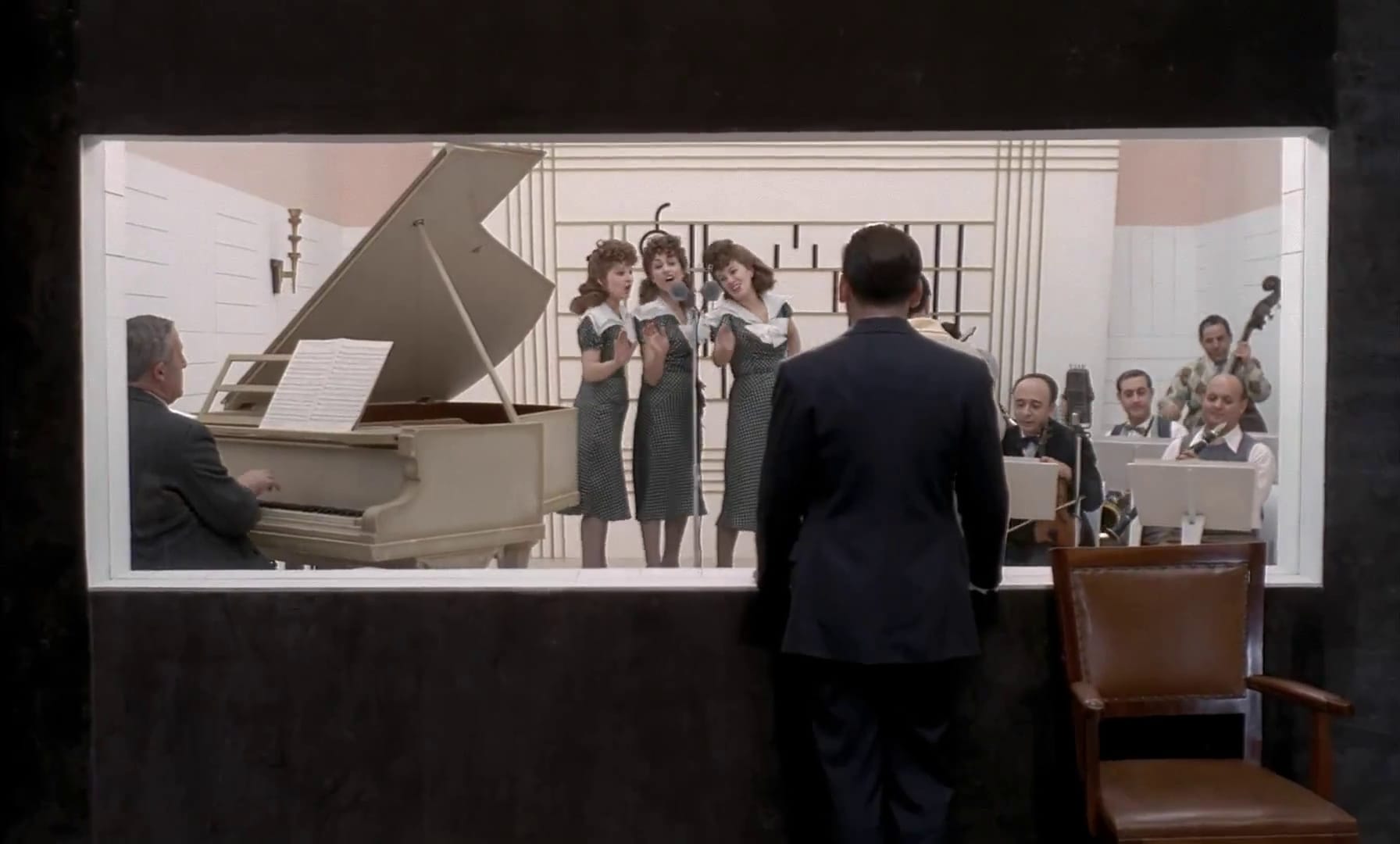
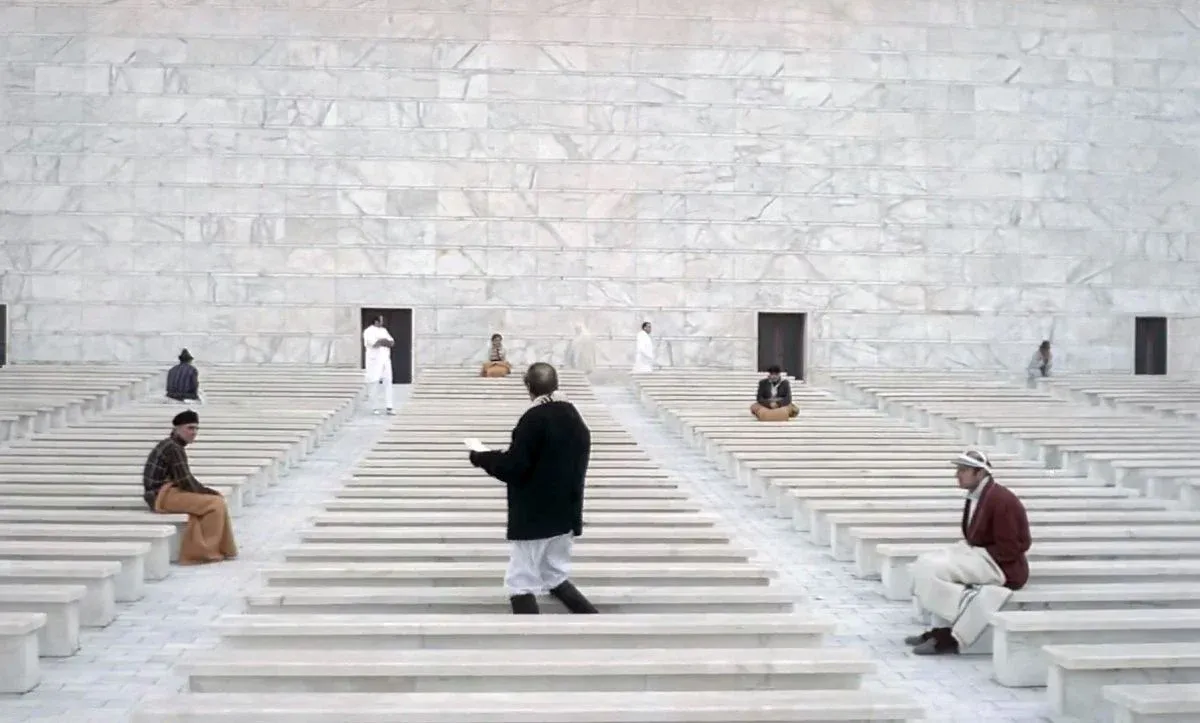
This internal imbalance is reflected in the external world. The film’s production design, particularly the use of the EUR district in Rome, is crucial. The EUR was commissioned by Mussolini to be a monument to Fascist modernity. Its architecture is rationalist, symmetrical, and cold – a "stone dream" of order.
When Marcello visits his father at the mental asylum (filmed at the Palazzo dei Congressi), the architecture dwarfs them. The vast, white, empty spaces reduce the human figure to an insect. This is the visual manifestation of Fascism: the individual is nothing; the State is everything. Marcello seeks this "annihilation" of the self. He wants to be a brick in the wall, indistinguishable from the others, held in place by the mortar of ideology.
Part III: The Myth of the "Normal Man"
The tragedy of Marcello Clerici is that he equates "conformity" with "normality." He believes that by acting like everyone else, he can cure himself of his trauma and his guilt. But Bertolucci ruthlessly exposes "normality" as a monstrous construct.
The film’s mouthpiece for this concept is, ironically, a blind man. Italo, Marcello’s friend and a devout Fascist, delivers a chilling monologue on what it means to be normal.
"A normal man," Italo says, "is one who turns his head to see a beautiful woman's bottom... and he is glad to find people who are like him, his equals... That's why a normal man is a true brother, a true citizen, a true patriot... a true fascist".
The irony is screaming at the viewer: Italo literally cannot "turn his head to see," yet he bases his entire worldview on visual conformity. His physical blindness serves as a metaphor for the moral blindness required to be a "good citizen" in a bad state.
The Dance of the Blind
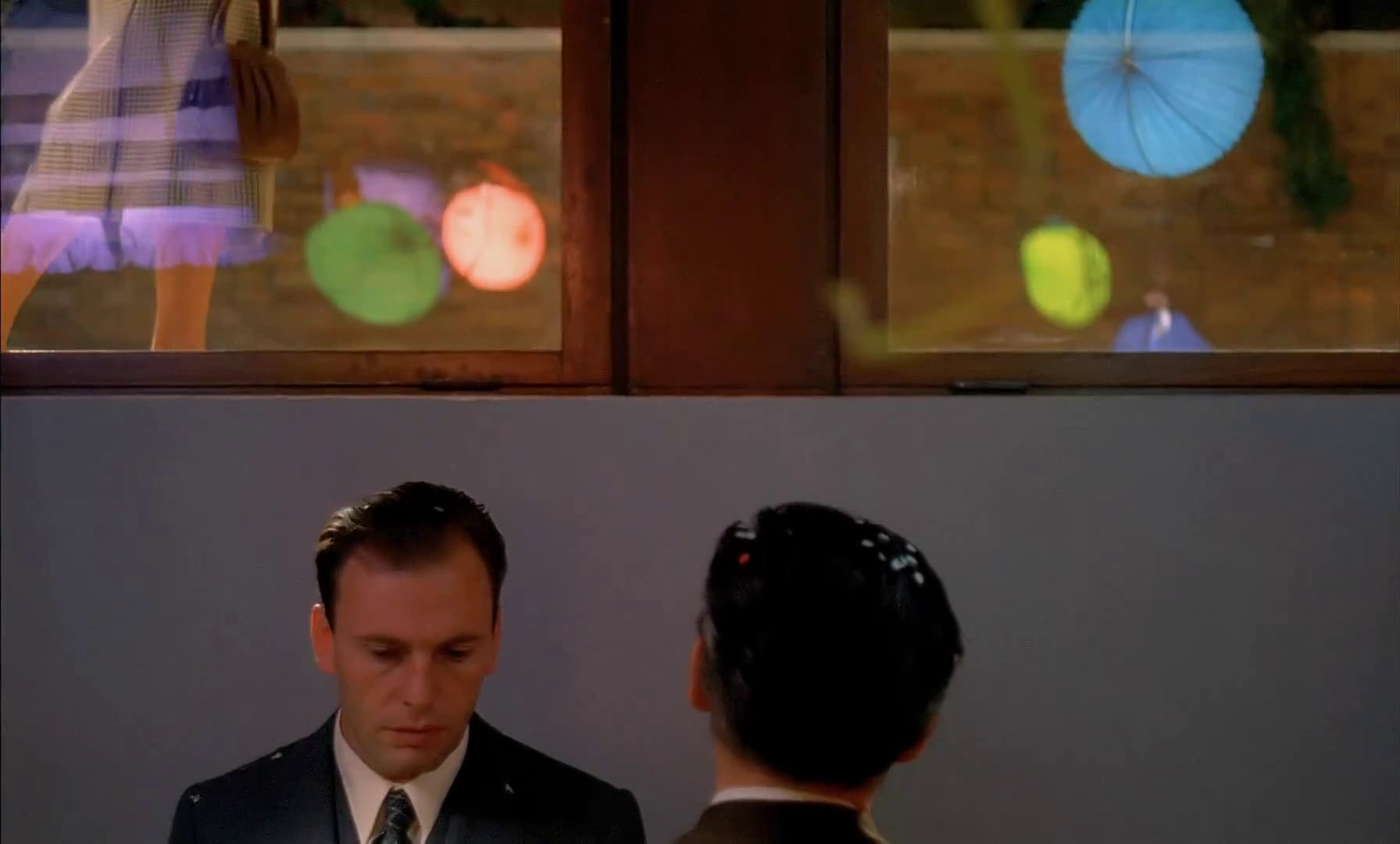
This metaphor culminates in the "Dance of the Blind" scene. Marcello visits Italo at a party held in a dark, basement-like apartment – another cave. The only light comes from street-level windows high up on the wall, where feet and shadows pass by. Inside, the blind guests navigate a world of darkness, convinced they understand the world better than those who can see. Marcello moves among them, "sighted" but spiritually blind, seeking validation from those who cannot even look him in the eye.
Part IV: Narrative as Disorientation
Bertolucci does not just show us Marcello’s confusion; he forces us to feel it. The film’s narrative structure is a labyrinth of flashbacks within flashbacks, destabilizing our sense of time and reality.
This is most evident in the depiction of Marcello's childhood trauma – the "primal scene" with the chauffeur Lino. When the young Marcello is lured into Lino's room, the camera angles become jagged and oblique. Throughout the film, Bertolucci often employs a "Dutch tilt" (canted angle), tipping the horizon line to create a sense of nausea and unease.
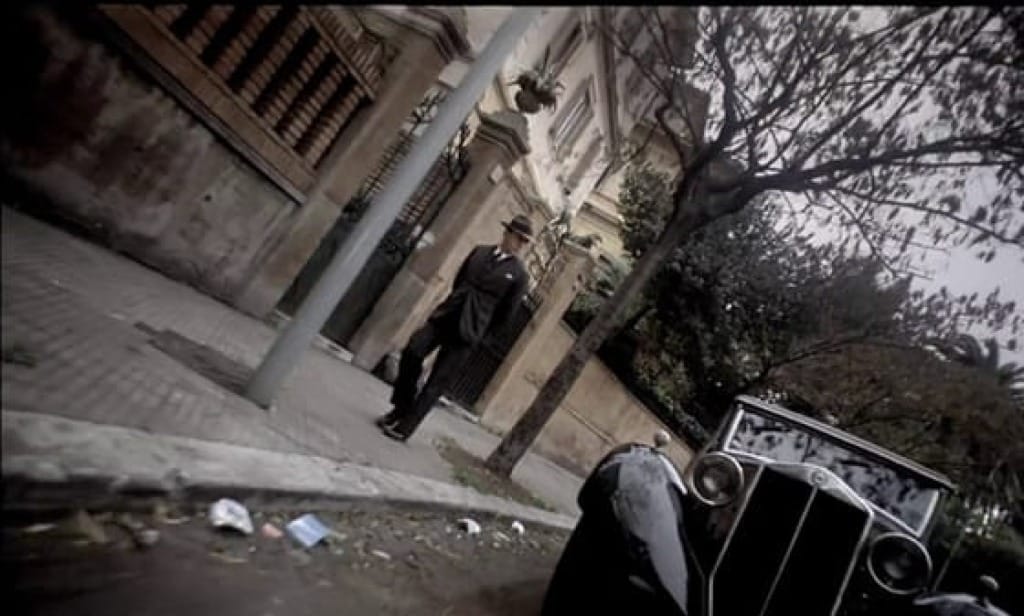
This visual language traps the audience in Marcello’s subjectivity. We are never quite sure what is real and what is a memory distorted by guilt. Did Marcello really kill Lino? Or is this a "shadow" he has projected onto his own history to justify his need for punishment and order?
By disorienting us, Bertolucci places the viewer in the position of the prisoner in the cave. We are struggling to discern the shapes in the dark, manipulated by the director’s "apparatus" just as Marcello is manipulated by the State.
Part V: The Light and the Good
If the Fascist world is one of shadows and artificial light, the realm of Truth is associated with the Sun. This is personified by Anna, Professor Quadri’s wife.
Throughout the film, Anna is bathed in light. She appears alongside lamps, bright windows, and open spaces. More specifically, she is linked to the Sun through a recurring costume detail: a scarab brooch. In Egyptian mythology, the scarab is associated with the Sun and rebirth. This brooch follows her from scene to scene, attached to her dress, her hat, or her purse.
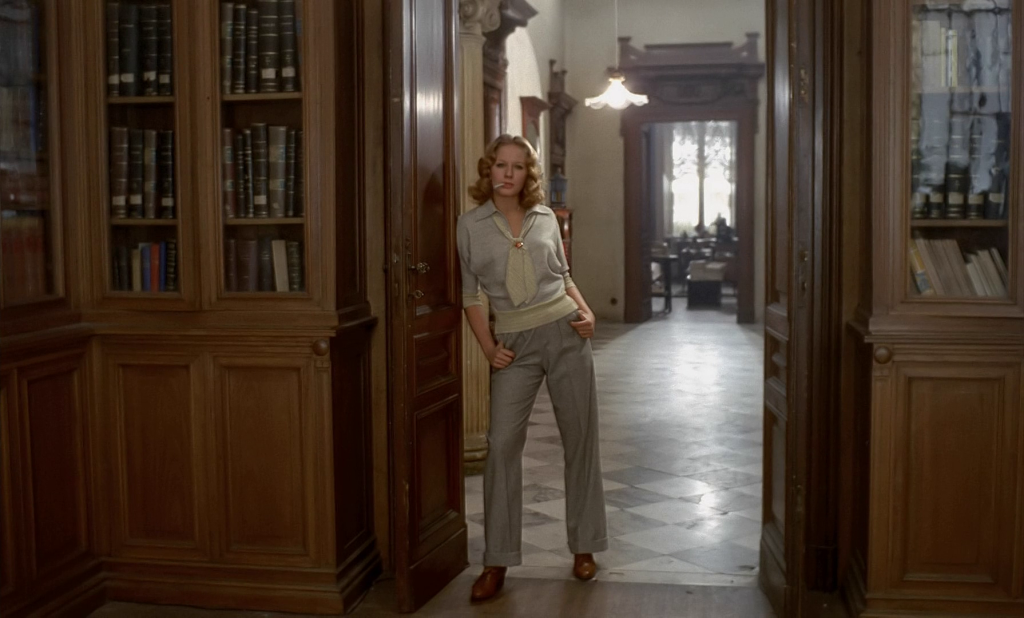
For Marcello, Anna represents the "Form of the Good"—the ultimate reality outside the cave. He is drawn to her not just sexually, but philosophically. He wants to "run off with Anna" in a dream where he regains his sight. But he cannot possess her because he cannot endure the light she represents. To be with Anna would require him to acknowledge his own individuality, his own freedom, and his own guilt.
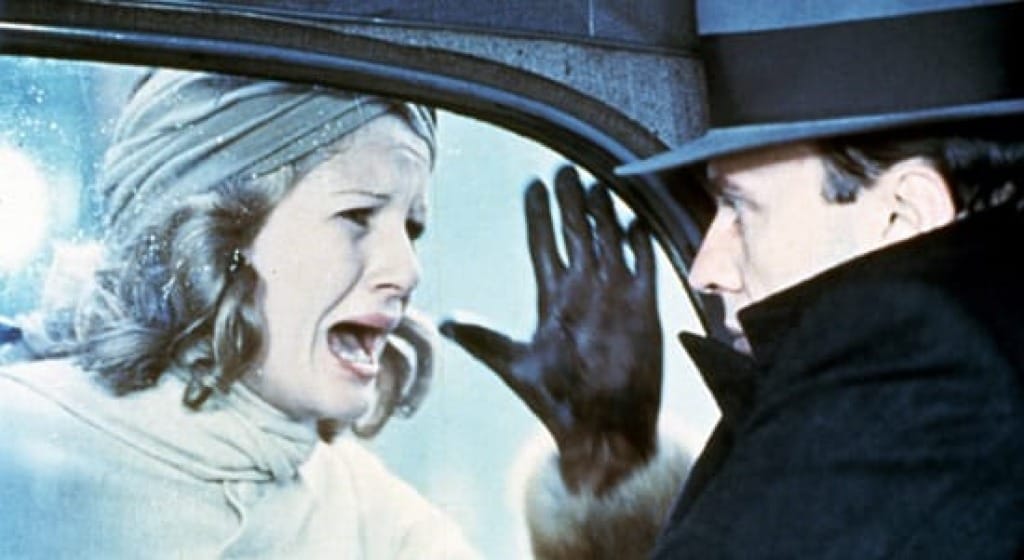
Instead, he destroys her. In the film’s most brutal sequence, Marcello sits encased in his car – a cage of glass and steel – while Anna is hunted down in the woods. He watches her death through the window, passive and immobile. He remains the spectator, the man in the dark, watching the light be extinguished.
Conclusion: The Reflection in the Mirror
The film does not end with redemption. It ends with a confrontation.
Years after the fall of Fascism, the "cave" has collapsed. Mussolini is gone. Marcello is no longer a man of the state; he is just a man. Walking through the ruins of the Colosseum, he stumbles upon a sleeping figure and realizes it is Lino—the man he thought he killed, the "shadow" that drove his entire life’s trajectory.
The foundation of his conformity was a lie. He didn't need to join the Fascists to absolve himself of murder, because the murder never happened.
In the final shot, Marcello sits in a small, grate-enclosed space, illuminated by a flickering fire. He turns to look back, but he doesn't look at Lino. He looks at us.
He stares directly into the camera lens, breaking the fourth wall. The red light flickers on his face, and because of the nature of the cinema screen, it flickers on our faces too.
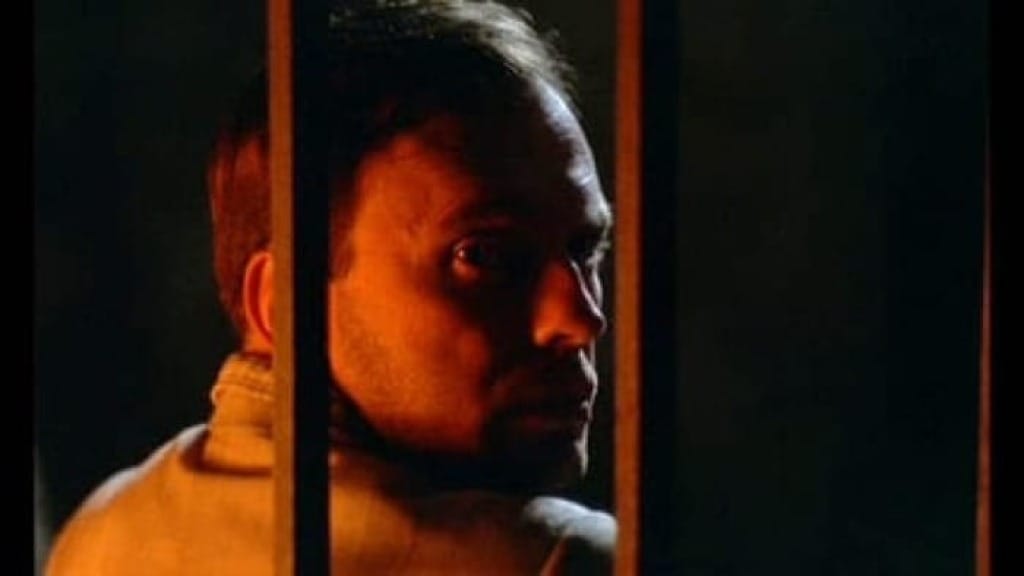
Bertolucci leaves us with a haunting, accusatory question. Marcello was a monster because he was ordinary. He was a man who did terrible things simply because he wanted to be safe, because he wanted to do what everyone else was doing. As he locks eyes with us, the screen fades to black, and we are left with our own reflection.
Are we any different? If the world turned dark tomorrow, would we have the courage to stand in the light? Or would we, like Marcello, seek the terrible safety of the cage?
A Question for the Community: Marcello Clerici commits terrible acts not out of malice, but out of a desperate need to be "normal." In our analysis, we argue that his passivity is his true crime.
Do you view Marcello as a victim of his trauma and the State, or is he fully responsible for the "shadows" he chooses to live in? And where do you see the "Cave" operating in cinema today?
Tell us your thoughts in the comments below. (Note: You must be a logged-in member to comment.)