The Cave and the Screen: Welcome to Film & Philosophy
In 1896, Maxim Gorky called cinema the "Kingdom of Shadows." Today, we ask: can we find truth in the illusion? Join us at the intersection of film and philosophy.

In 1896, Maxim Gorky visited the Lumière cinematograph and described it as the "Kingdom of Shadows." He wrote of a world without sound or colour, dipped in monotonous grey - not life, but its spectre.
For the philosopher, this "Kingdom of Shadows" strikes a familiar chord. In his Cave Allegory (Republic, c.360 BCE), Plato presents a strikingly visual account of the distinction between knowledge and belief. In doing so, he provides us with what may be considered the earliest description of a cinema.
The Mechanics of the Cave
Plato (514a-517a) invites us to imagine humanity as prisoners who have been captive since birth in an underground chamber. There they sit, facing the back wall of the cave, unable even to turn their heads.
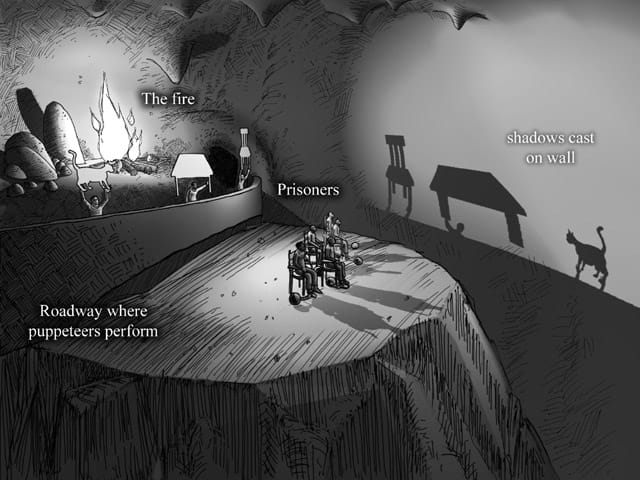
Behind them, and higher up, a fire is burning. Between the fire and the prisoners runs a road, along which a wall has been built. Along this road, men carry artifacts, and the fire projects the shadows of these artifacts onto the back wall of the cave. The prisoners, Plato writes, “would believe that the shadows of the objects … were the whole truth” (515c).
Plato asks us to consider what would happen if a prisoner were compelled to stand and turn to face the fire. What if he were “forcibly dragged up the steep and rugged ascent and not let go till he had been dragged out into the sunlight” (516a)?
Eventually, the released prisoner would realize that what he used to take for reality was nothing but shadow and illusion. He would see clearly. Yet, if he returned to the cave to convince his former fellow prisoners of their illusory state, he would not be welcomed. Plato warns that “if anyone tried to release them and lead them up, they would kill him if they could lay hands on him” (517a)—a sombre allusion to the execution of Socrates.
Plato's Allegory of the Cave, narrated by Orson Welles
The Cinema vs. The Cave
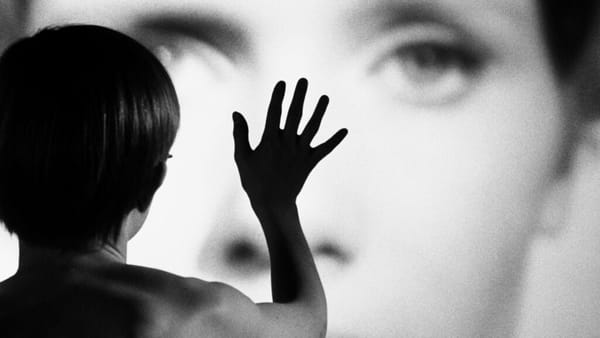
Plato’s Cave strikes us as very familiar to the modern cinema experience. We, too, sit in the dark, watching projected images play out a drama on the screen before us.
However, there is a vital distinction between Plato's prisoners and the modern cinema-goer. Plato’s prisoners are unaware that what they see is mere shadow; they take it for reality. We, on the other hand, are able to distinguish what we see on the screen from 'the real world' outside.
Because we are not deceived, we can reverse the trap: unlike the prisoners, we can use film to gain insight into the world outside the cinema.
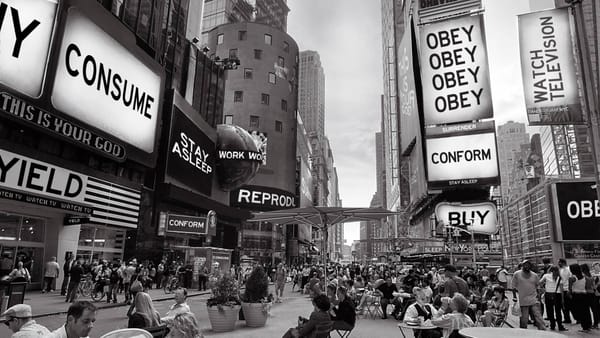
It is worth pausing to note here that the situation is not always so straightforward - the situation is not always so straightforward. We can all be seduced by fiction, just as we can be swayed by the 'truth' of a documentary.
The Cave in Film
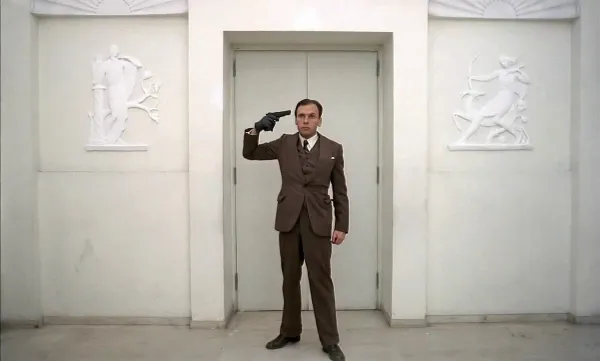
Plato’s allegory has haunted the cinema since its earliest days, and has received treatment by a range of directors from Kubrick (A Clockwork Orange, 1971), to Tornatore (Cinema Paradiso, 1998), to the Wachowski Siblings (The Matrix, 1999). Perhaps the most explicit illustration, however, is found in Bernardo Bertolucci’s The Conformist (Il Conformista, 1970). This intersection is nowhere more visible than in Bertolucci’s masterpiece, where the cave is not just a metaphor, but a plot point. It serves as a reminder that cinema is not mere illusion or just entertainment, but instead forces us to challenge our deep-held beliefs.
We invite you to join us in this "Kingdom of Shadows" - not to escape the world, but to better understand it.