Dogtooth: Social Engineering and the Limits of our World
Event Details & Booking:
Dogtooth continues our season exploring Free Will & Determinism at the Edinburgh Filmhouse. Join us for a screening and discussion on Tuesday 3 November 2026.
👉Reserve your seats at Filmhouse Edinburgh
Spoiler Warning: The following contains narrative spoilers, including plot details and the final resolution. If you have yet to watch the film, you may wish to bookmark and return to read after viewing.
The Boundaries of the Garden
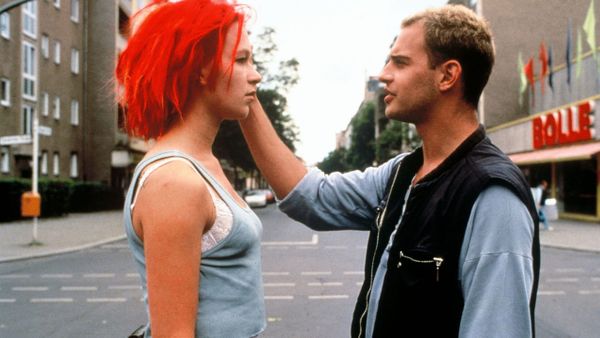
In Tom Tykwer’s Run Lola Run, the threat to human freedom was physical and immediate: seconds ticking on a stopwatch, intersecting trajectories on Berlin pavements, and the relentlessness of univeral cause and effect. With Yorgos Lanthimos’s Dogtooth (Kynodontas, 2009), the deterministic net is cast less widely.
The film opens with an audio cassette lesson. A calm, maternal voice recites vocabulary definitions to three adult siblings who have never left the manicured grounds of their suburban villa:
- A "sea" is a wooden armchair.
- A "motorway" is a strong gust of wind.
- An "excursion" is a durable material used to make floors.
- A "carbine" is a beautiful white bird.
Lanthimos presents us with an extreme thought experiment in social engineering. The parents have isolated their grown children from society, informing them that the world beyond the fence is fatal and that an individual is ready to leave only when their right canine - their "dogtooth" - falls out.
Most narratives of confinement frame the prison as a physical constraint on our freedom. Dogtooth demonstrates that the most inescapable boundary is not made of concrete, but of concepts.
Wittgenstein and the Semantic Cage
In the Tractatus Logico-Philosophicus, Ludwig Wittgenstein famously observed: "The limits of my language mean the limits of my world."
Language does not merely label a pre-existing reality; it structures our capacity to think about it. If you lack the word for an ocean, or if the word has been deliberately attached to a piece of furniture, the desire to cross an ocean cannot formulate in your mind. The father in Dogtooth does not need armed guards at the driveway because he has achieved something far more total: he has preemptively amputated the conceptual apparatus required to imagine an outside.
When an airplane roars overhead, the siblings scramble into the garden not to gaze up at a people flying to another country, but to prepare catch the toy plane that may fall into the garden. The parents periodically toss small plastic aircraft over the hedgerow, confirming the children's belief that planes are tiny, falling objects to be caught and prized.
Every encounter with the world is filtered through a false grammar. By severing words from their referents, the parents construct an artificial epistemic reality. Freedom of choice is rendered meaningless when the categories through which choices are conceived have been falsified at the root.
Susan Wolf and the Sane Deep-Self
Contemporary philosophers attempting to salvage free will from derminism often argue that an agent acts freely as long as their actions align with their desires -specifically, second-order desires that reflect what Harry Frankfurt termed the "deep self." On this view, if you want what you want, and nothing external forces or fetters you, your choice is your own.
Yet Dogtooth exposes the deep flaw in that equation. The American philosopher Susan Wolf argued that desire-alignment is not enough. In developing her Sane Deep-Self View, Wolf insisted that moral responsibility and genuine autonomy require an agent’s deep self to be sane - defined specifically as the ability "cognitively and normatively to recognise and appreciate the world for what it is."
When the eldest daughter sits alone in the bathroom with a heavy dumbbell, striking her face until her canine tooth is smashed out of her jaw, she is exhibiting deliberate, concentrated agency. She wants to leave; the father's house rule dictates that one can leave when a canine tooth falls out; she forces the condition to be met.
Under a crude definition of free will, this is an autonomous act of self-emancipation. But through Wolf's lens, the tragedy is that her agency remains fundamentally broken. She has absorbed a false normative order so completely that she cannot recognise her condition for what it is. Her escape is not an assertion of authentic liberty; it is an act of self-mutilation governed by the very rules used to subjugate her.
Thinking Film
The proposition that cinema can think for itself finds a severe, deadpan realisation in Lanthimos’s frame.
The camera in Dogtooth rarely tracks fluidly or offers comfortable points of identification. It crops bodies at awkward angles, slices heads out of frame, and observes ritualistic cruelties with the cold, static indifference of surveillance footage. The cinema screen itself acts as an accomplice to the fence, withholding the world outside until we share the family's claustrophobia.
The film leaves us not with a triumphant escape, such as Truman's satute at the top of the stairs, but with the eldest daughter curled inside the dark boot of her father's Mercedes, waiting in silence. We never see whether she suffocates, whether she is discovered, or whether the car carries her out into a world she has no conceptual tools to navigate.
In doing so, Dogtooth turns the question back onto the spectator. We may laugh at the absurdity of children barking like guard dogs or mistaking salt cellars for telephones, but how clean are our own conceptual frameworks? How much of our own moral compass, our desires, and our everyday choices are the product of sane reflection - and how much has been dictated by the invisible semantic fences of the cultures, families, and algorithms that house us?