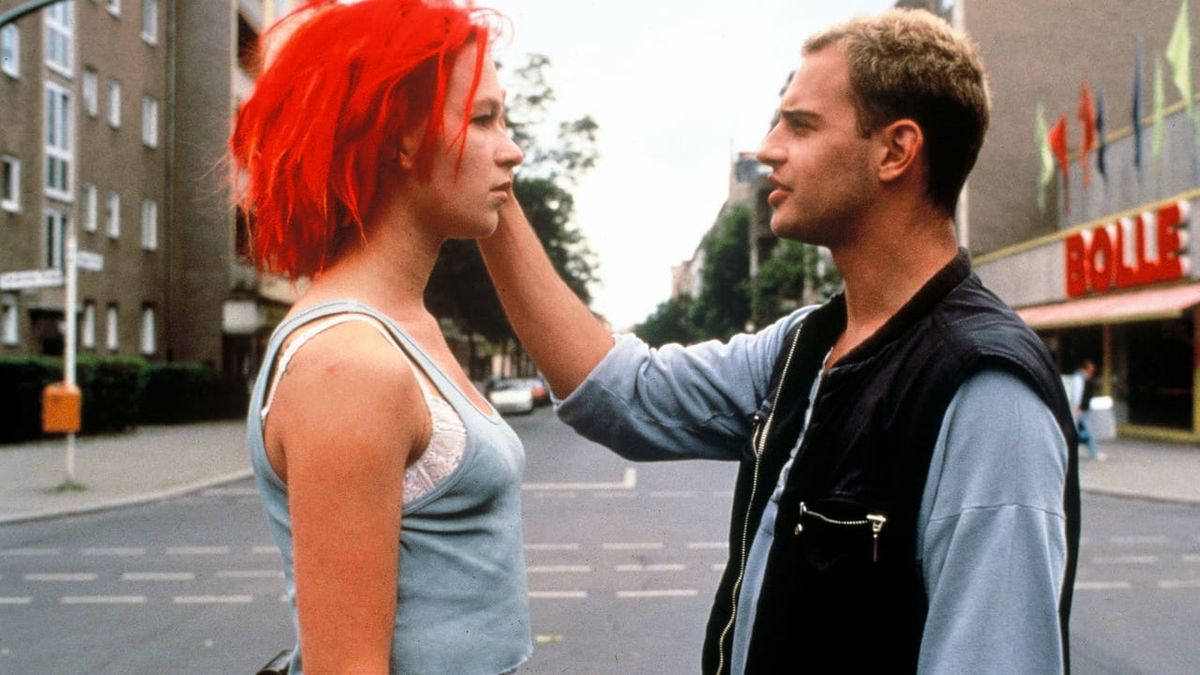
Run Lola Run: a kinetic thought experiment in universal causality
Event Details & Booking:
Run Lola Run opens our new season exploring Free Will & Determinism at the Edinburgh Filmhouse. Join us for a rare big-screen presentation and live philosophical salon on Tuesday 6 October 2026.
👉Reserve your seats at Filmhouse Edinburgh
Spoiler Warning: The following contains narrative spoilers, including character fates and the final resolution. If you have yet to watch the film, you may wish to bookmark and return to read after viewing.
The Tyranny of the Split Second
Before Lola takes her first stride down the staircase in Tom Tykwer’s Run Lola Run (Lola rennt, 1998), a pendulum swings through darkness, swallowed by the grotesque face of a clock. Over it, a narrator asks the questions philosophy has wrestled with for centuries: Who are we? Where do we come from? Where are we going?
Most films answer that last question comfortably. Characters make deliberate choices, face consequences, and arrive at an ending they somehow earned through character and morality. Tykwer immediately dismantles that comfort.
The premise is stripped of exposition: Manni has left 100,000 marks on a Berlin subway train; a ruthless gangster will execute him in twenty minutes; Lola must find the money and cross the city to stop him.
Then the film resets. Three times.
Each run starts from the exact same telephone call, yet each fractures into an entirely different reality. Tykwer isn't just borrowing the structure of a video game; he is staging a direct confrontation between the laws of cause and effect and the possibility of human choice.
The Staircase, the Butterfly Effect, and Spinoza’s Web
The engine driving the film is what chaos theorists call sensitive dependence on initial conditions - more familiar to most of us as the butterfly effect.
Watch Lola on the staircase:
- In the first run, a man’s dog makes her hesitate for a fraction of a second.
- In the second, the boy trips her.
- In the third, she clears the hurdle cleanly.
That tiny gap in time - a couple of heartbeats - reshapes everything that follows. Arriving at the street corner two seconds earlier or later determines whether she collides with an ambulance, whether a bank manager steps out of an office, or whether Manni spots the blind beggar holding his cash.
Tykwer visualises these ripples through rapid-fire Polaroid snapshots of the pedestrians Lola brushes past:
- The woman with the pram becomes a destitute mother whose child is taken into care in one reality; in another, she wins the lottery; in the third, she finds religion.
- The cyclist selling Manni’s bike is beaten to death in one timeline, yet happily married to a nurse in another.
These vignettes aren't just clever visual flourishes. They point toward a very Spinozan picture of the world. For Baruch Spinoza (1632-1677), the universe is an interconnected web of necessity: every event is bound to an unbroken chain of prior causes, and our belief in free will is largely an illusion born from ignorance of those hidden causes.
Lola isn't trying to change these strangers' lives - she barely registers them. Yet her hurried sprint redistributes tragedy, joy, and fortune across people who will never know her name. It suggests an uncomfortable ambient ethics: our moral footprint isn't just about the major choices we agonise over, but the physical wake we leave behind simply by moving through a shared world.
Nietzsche, Amor Fati, and the Third Run
The first run ends with Lola shot dead by a stray police bullet; the second ends with Manni crushed beneath an ambulance. The third ends with both walking away unharmed, pockets full of cash.
Why does the third run succeed?
Between the runs, Tykwer places Lola and Manni in a dreamlike, red-lit bedroom, talking through love, death, and doubt. There is a quiet suggestion that some trace of memory carries over. In the third run, Lola runs smarter. When she bursts into the casino to gamble her last marks, she doesn't merely place a bet - she screams with enough force to shatter the champagne flutes, willing the roulette ball to land on 20 twice in a row.
Here, the film enters the territory of Friedrich Nietzsche (1844-1900). In The Gay Science, Nietzsche introduced the Eternal Recurrence as a supreme test: if you had to relive your life in exact detail infinite times, would you curse the fate that trapped you, or embrace it with absolute joy? Lola’s sprint looks like an embodiment of Nietzsche’s amor fati - not a passive surrender to destiny, but an active, passionate embrace of the challenge until reality bends to human will.
Yet Tykwer leaves room for a more grounded reading:
- Did Lola’s passion genuinely break the deterministic rules of reality through willpower alone?
- Or does the film simply demonstrate the cold mathematics of probability? In an infinite sequence of attempts, hitting 20 twice in a row is wildly improbable, but not impossible. The third run might just show us what happens when sheer blind luck finally lands on your side.
Thinking Film
As Stephen Mulhall argued, films do not have to merely illustrate philosophical essays written on paper; cinema can think for itself.
Run Lola Run doesn't discuss determinism through dry dialogue. It thinks through split screens, animation, tracking shots, and a 130-BPM techno score that turns the ticking clock into a somatic pulse. By setting out twenty minutes as a visible map of branching paths—much like Jorge Luis Borges’ The Garden of Forking Paths—the film captures the real tension of modern life: we are hemmed in by circumstances, clocks, and habits we didn't choose, yet we still have to act as though every split-second choice has the power to remake our world.